
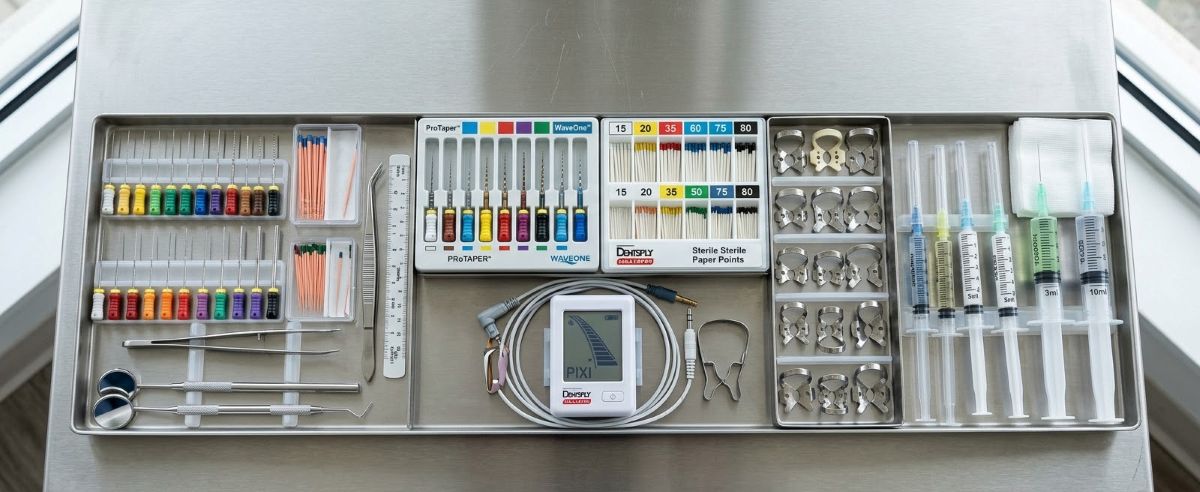
Every root canal, retreatment, and pulpotomy depends on having the right endodontic supplies & instruments stocked and ready before the patient sits down. A gap in inventory, whether it's a missing rotary file size or an expired sealer, turns a routine procedure into a scheduling problem. This guide covers what a fully equipped endodontic operatory needs, how to evaluate instruments and materials beyond sticker price, and how to keep a supply room organized so reorders never become emergencies.
Complete Endodontic Instrument & Equipment Checklist
Before placing a new order, it helps to audit what's already on the tray and in the supply cabinet. Browsing a full collection of endodontic supplies and instruments ahead of time gives a clear picture of what's available before committing to reorder quantities. A complete inventory of endodontic supplies and instruments covers three categories: the hand instruments used chairside, the equipment that supports diagnosis and canal shaping, and the consumables used up procedure after procedure. Reviewing all three against current caseload keeps a practice from over-ordering in one area while running short in another.
Standard Root Canal Tray Setup: Essential Tools & Layout
A standard tray includes an endodontic explorer, spoon excavator, mirror, cotton pliers, a millimeter ruler, and clamp forceps, as well as irrigation syringes and absorbent paper points. Sourcing a consistent set of endodontic products for every tray makes it easier to standardize setups across operatories, so associates and hygienists aren't hunting for substitutes mid-procedure.

Hand Files vs. Rotary NiTi Files: Selecting the Right System
Hand files remain useful for negotiating tight, curved, or calcified canals where tactile feedback matters more than speed. Rotary nickel-titanium systems significantly reduce shaping time and produce more consistent tapers in straightforward canals, though they carry a higher risk of separation if torque and speed aren't matched to the file design. Many practices stock both, drawing on a hand-file selection for difficult anatomy and a rotary file system for routine cases, matching endodontic supplies and instruments to canal difficulty rather than defaulting to a single system for everything.
Working Length Equipment & Electronic Apex Locators
An electronic apex locator paired with periapical radiographs gives a more reliable working length than radiographs alone, particularly in canals with unusual curvature. Calibration and probe condition should be checked routinely, since a worn lip clip or a corroded file clip introduces measurement error that later shows up as under- or over-instrumentation.
Irrigation, Isolation & Canal Preparation Supplies
Canal disinfection and a dry, isolated field determine long-term treatment success as much as instrumentation does. Choosing the right dental endodontic supplies for irrigation and isolation directly affects how well a canal system is cleaned and how much retreatment risk a practice takes on later.
Irrigation Solutions, Needles & Activation Devices
Sodium hypochlorite remains the standard irrigant for its antimicrobial and tissue-dissolving properties, typically paired with EDTA to remove the smear layer. Side-vented irrigation needles reduce the risk of solution extrusion past the apex compared to open-ended needles, and sonic or ultrasonic activation improves irrigant penetration into lateral canals and isthmuses that passive irrigation alone won't reach.
Isolation Essentials: Rubber Dam Kits, Clamps & Frames
Rubber dam isolation is a baseline safety and infection-control standard for endodontic treatment, not an optional step. A complete rubber dam kit should include a range of clamp sizes for molars, premolars, and anteriors, along with frames and dam material in both latex and latex-free options for patients with sensitivities.
Post-and-Core Materials: Posts, Pins & Core Build-Up Supplies
Once a canal is obturated, a tooth with significant coronal structure loss usually needs a post-and-core foundation before final restoration. Fiber posts have largely replaced metal posts in anterior and premolar teeth due to their more favorable elastic modulus, while posts, pins, and core accessories in a range of diameters allow a practice to match the post to the canal geometry rather than forcing a single system on every case.
Obturation Systems, Sealers & Repair Materials
Final obturation choices affect both the immediate radiographic result and the tooth's long-term prognosis. Comparing obturation systems for viscosity, setting time, radiopacity, and delivery method helps a buyer match the material to the technique rather than defaulting to whatever was ordered last time.
Gutta-Percha Points, Bioceramic Sealers & Delivery Devices
Gutta-percha remains the core filling material in the vast majority of cases, but the choice of sealer has shifted meaningfully toward bioceramic formulations. Bioceramic sealers offer better dimensional stability and bioactive interaction with dentin than older resin- or zinc oxide eugenol-based sealers, though they typically cost more per unit and require closer attention to shelf life.

Warm Vertical vs. Cold Lateral Obturation Equipment
Cold lateral condensation requires minimal equipment investment and remains a dependable technique for straightforward canals. Warm vertical compaction, using a heat source and pluggers, achieves denser fill in accessory canals and irregular anatomy, but adds equipment costs and a learning curve that should be factored into the purchasing decision.
Endodontic Repair Materials: MTA & Bioceramics Selection Guide
Mineral trioxide aggregate and newer bioceramic putties are used for perforation repair, pulp capping, and apexification. When comparing products, working time, handling consistency, and radiopacity matter more than brand name alone, since a material that sets too quickly in a humid field can compromise the repair.
Purchasing Strategy: Balancing Price, Quality & Value
Buying endodontic supplies & instruments based solely on price tends to cost more over the year than it saves upfront. A more accurate way to evaluate a purchase is cost-per-procedure, which accounts for file survival rate, retreatment risk, and chair time, not just the invoice total. For a broader framework on evaluating dental vendors and product categories across a practice, the dental supply buying guide applies the same cost-per-use logic practice-wide.
Total Cost of Ownership: Quality vs. Upfront Purchase Price
A rotary file that separates on the third use isn't cheaper than one that lasts through several cases once lost chair time and patient rescheduling are factored in. Evaluating endodontic supplies and instruments in terms of total cost of ownership means weighing durability, failure rate, and reorder frequency alongside the sticker price.
Maximizing Efficiency: How Product Quality Reduces Clinical Chair Time
Higher-consistency files and predictable sealers reduce the number of adjustments and retries during a procedure. Shaving even a few minutes off each root canal compounds across a full schedule, which is where instrument quality shows up on a practice's bottom line rather than just on the supply invoice.
Vendor Selection: Specialized Endo Suppliers vs. General Dental Distributors
When sourcing endodontic supplies and instruments, a specialized endodontic supplier typically carries a deeper range of file, sealer, and obturation SKUs than a general distributor, along with staff who understand compatibility questions between systems. A general distributor may still make sense for practice-wide disposables and infection-control items ordered alongside endo materials in a single shipment.
Practice Operations: Inventory Management & Smart Ordering
Even well-chosen materials lose value if they expire on a shelf or run out mid-procedure. Treating inventory of endodontic supplies and instruments as an operational system, not a reactive task, is what separates practices that reorder efficiently from ones placing rush orders every few weeks.
How to Buy Endodontic Supplies Online with Confidence
When you shop endodontic instruments online, confirm lot numbers, expiration dates, and regulatory-cleared status before checkout, and keep a reorder list tied to actual case volume rather than guesswork. Practices that regularly purchase endodontic dental products and supplies from a single trusted distributor also simplify invoicing and warranty tracking compared to splitting orders across multiple vendors.
Stocking Tactics: Preventing Overstocking, Waste & Expiration
Rotate stock on a first-in, first-out basis and set par levels based on average monthly case volume rather than round numbers. Sealers, bonding agents, and irrigation solutions with defined shelf lives are the most common source of expired-product waste, so these deserve tighter review than shelf-stable metal instruments.
Standardizing Practice Supplies to Lower Annual Purchasing Costs
Practices that run multiple operatories or associates often lose money due to inconsistent product choices across rooms. Standardizing which files, sealers, and isolation kits each operatory stocks, and choosing one place to shop for endodontic equipment and consumables, reduces duplicate SKUs and makes annual spend easier to forecast.
Frequently Asked Questions
How can I reduce supply costs without compromising clinical outcomes?
-
Track cost per procedure rather than cost per item, and standardize instrument and material choices across operatories to reduce duplicate SKUs. Buying core endodontic dental supplies in appropriately sized case quantities from one distributor typically lowers per-unit cost without changing what's used chairside.
What features should I compare before buying rotary files online?
-
Compare taper, tip size, alloy type (conventional versus heat-treated NiTi), and manufacturer-stated cycle counts before comparing price. A file with a higher fatigue-resistance rating may cost more per unit but reduce separation incidents, which affect both patient safety and chair time.
How does reducing material waste lower total endodontic expenses?
-
Expired sealers, obturation materials, and irrigation solutions represent a direct loss with no clinical return. Rotating stock on a first-in, first-out basis and ordering based on actual usage data, rather than round-number reorders, keeps waste on endodontic supplies and instruments as close to zero as possible.
What are the benefits of buying from a specialized endodontic supplier?
-
A specialized supplier typically stocks a wider range of file systems, sealer chemistries, and post-and-core materials than a general distributor, along with more specific compatibility guidance. This matters most for practices performing a high volume of endodontic procedures, where system-specific accessories need to be consistently in stock.
How do I audit my practice's current endodontic inventory for overspending?
-
Start by counting what's actually on hand against a checklist of core categories: hand and rotary files, irrigation and isolation supplies, obturation materials, and post-and-core components. Compare that count against the last three months of case volume to see where the practice is overstocked, understocked, or paying for redundant endodontic supplies and instruments across multiple brands.
Ready to Restock Your Operatory?
A well-stocked endodontic setup starts with sourcing that keeps pace with the caseload rather than falling behind. Alpine Dental Inc. carries files, obturation systems, isolation supplies, and repair materials for practices across the United States and Canada looking to standardize their endodontic supply chain.