
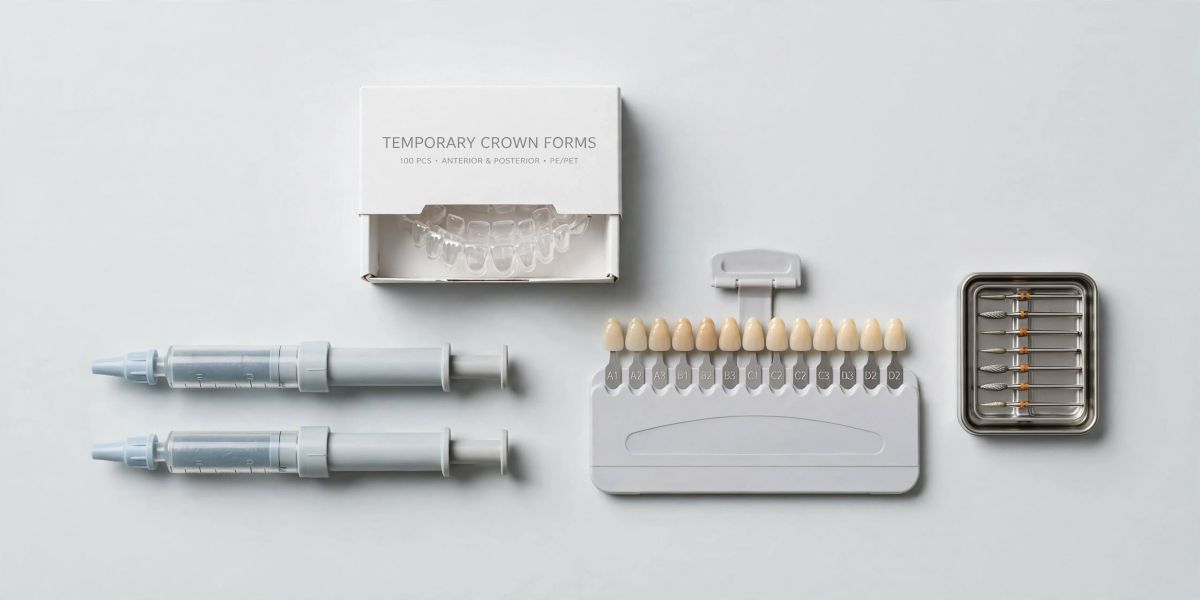
Stocking a practice for crown and bridge work means managing more than one product line. Impression materials, cements, temporary crown forms, and finishing burs each carry their own shelf life, storage rules, and cost tradeoffs. This guide walks through the clinical basics, material choices, and purchasing decisions that keep a restorative workflow running without delays or waste. It's written for office managers, general dentists, and procurement staff ordering crown and bridge supplies for a practice or lab.
Fundamentals of crown and bridge restorations
What is a dental crown?
A dental crown is a single-unit, full-coverage restoration that covers a prepared tooth above the gumline. Crowns are indicated for endodontically treated teeth, teeth with extensive decay that can't support a direct filling, and cases of cracked tooth syndrome where a cusp or the whole tooth needs full coverage to prevent fracture.
How dental bridges replace missing teeth
A dental bridge is a fixed partial denture that spans a gap left by one or more missing teeth. It relies on abutment teeth on either side of the gap to support pontics, the artificial teeth that fill the space. The structural load a bridge carries and the span it needs to cover determine how much material strength the restoration requires. A three-unit bridge replacing a single premolar has different demands than a longer span replacing multiple posterior teeth.
Bridges vs. dental implants: indications and materials
Bridges and implants solve the same problem through different means, and the choice usually comes down to bone availability, systemic health factors, cost, and time to completion. Implants require adequate bone volume and healing time before a final restoration is placed. Bridges avoid a surgical step but require sound abutment teeth capable of supporting the load. On the supply side, implant cases call for fixture hardware and abutment components, while bridge cases draw on restorative materials, impression systems, and cementation supplies. For cases where a fixed bridge isn't indicated, removable options built from denture base and framework materials remain a practical alternative for some patients.

Materials and types of restorations
Common restoration materials
Zirconia crowns come in monolithic and layered forms. Monolithic zirconia has high flexural strength (typically 900–1,200 MPa) and holds up well under heavy occlusal load, though it can be more abrasive to opposing natural dentition than layered ceramics, especially when not thoroughly polished. PFM (porcelain-fused-to-metal) restorations have a long clinical track record and strong mechanical reliability, with the tradeoff of a metal margin that can show at the gumline over time. All-ceramic materials such as lithium disilicate offer strong esthetics and are a common choice for anterior restorations, though they generally have lower flexural strength (around 360–400 MPa) than zirconia and are used more selectively in high-load posterior cases.iso+5
Traditional lab-made vs. in-office CAD/CAM restorations
In-office CAD/CAM systems require their own supply chain: milling blocks in zirconia or glass-ceramic, crystallization furnace consumables, and characterization stains and glazes for shading. Traditional lab-based workflows depend on reliable impression materials or digital scanner bite registrations, shade guides, and provisional materials while the case is out at the lab. Neither workflow is inherently better. The choice affects which crown & bridge products a practice needs to keep in inventory. When evaluating dental crown & bridge products, focus on material strength, esthetics, and workflow compatibility.
Types of dental bridges and material requirements
Traditional bridges use full-coverage retainer crowns on both abutments and suit longer spans or higher load cases, generally calling for high-tensile zirconia or PFM. Cantilever bridges anchor to an abutment on only one side and are reserved for lower-load situations. Maryland bridges use resin-bonded wings instead of full crowns and depend on etching and bonding materials rather than conventional cementation. Each bridge type changes what a lab or chairside team needs on hand.
The crown and bridge workflow and required supplies
Impression materials: VPS, polyether, and digital scanners
Dental impression materials fall into a few main categories, each suited to different clinical situations. Vinyl polysiloxane (VPS), also called polyvinyl siloxane (PVS), is hydrophobic, dimensionally stable, and available in fast-set and regular-set formulations depending on chair time constraints. Polyether is hydrophilic, which makes it a strong choice for detail capture in damp fields, and it sets to a rigid, tear-resistant material—though that rigidity can make removal more challenging around undercuts or multi-unit abutments. Both approaches depend on supporting supplies: tissue retraction cords or hemostatic agents to manage the sulcus, full-arch or dual-arch impression trays, and scan spray for digital cases. A well-stocked impression materials collection covers both conventional and digital workflows.

Temporary vs. permanent crown and bridge materials
Temporization typically relies on bis-acryl self-cure resins, acrylics, or preformed temporary crowns in aluminum or polycarbonate, held in place with eugenol or non-eugenol temporary cement depending on whether a permanent resin cement will be used later. Preformed crown forms speed up chairside temporization compared to shaping a custom shell. For a closer look at how temporary and permanent materials fit into the broader restorative category, see this restorative dental supplies guide. Permanent restorations arrive either lab-milled or as chairside CAD/CAM blocks, depending on the workflow the practice uses. Stocking dedicated temporary crown and bridge material separately from permanent cementation supplies helps avoid mix-ups during a busy day.
Cements, bonding agents, and etchants
Self-adhesive resin cements are versatile and moisture-tolerant, making them a common default for many crown and bridge cases. Adhesive resin cements offer higher retention but require a separate etching and bonding step, which makes them a better fit for short abutments or preparations with limited retention form. Glass ionomer and resin-modified glass ionomer (RMGI) cements release fluoride and clean up easily, which some practices prefer for standard full-coverage crowns on well-retentive preps. Resin cements typically have a shelf life of one to two years unopened, with some manufacturers specifying use within 6–18 months after opening for self-adhesive systems; storage temperature matters. Check the manufacturer's labeling for the specific product in use, since shelf life claims are not standardized across brands.
Preparation, finishing, and polishing burs
Diamond burs in coarse or medium grit handle depth cuts and bulk reduction, while fine and superfine grits refine chamfer or shoulder margins. Carbide burs are used for prep removal and fine adjustment. Polishing kits with rubber points and diamond pastes allow for intraoral adjustment of zirconia and lithium disilicate restorations without sending a case back to the lab. Rounding out the workflow, a stocked set of crown and bridge accessories covers the smaller items, articulating paper, contact gauges, and try-in pastes that keep a seating appointment moving.
Buying considerations: what to stock in your practice
High-volume essentials vs. specialty items
Some crown & bridge products belong on a standing reorder list: VPS material, retraction cord, temporary cement, and everyday prep burs get used in nearly every case. Specialty items, such as rare-shade CAD/CAM blocks or esthetic cements for anterior cases, are better ordered just in time rather than held as standing stock, since they turn over more slowly and tie up cash sitting on a shelf.
Evaluating cost, shelf life, and supplier dependability
Bonding agents and impression materials expire faster than most practices expect, so checking expiration dates at the time of order, not just at the time of use, matters. When comparing price, look at cost per unit of use rather than the sticker price of a box. A cartridge system with a higher up-front cost per box can still be cheaper per impression than a bulk hand-mix system once waste is factored in. On the supplier side, lead times, return policies for short-dated stock, and backorder rates all affect whether a practice can rely on a vendor during a busy month.advancedentalexport+1
Inventory management tips for dental practices
A first-in, first-out (FIFO) rotation keeps older stock from expiring on the shelf behind newer deliveries. Setting minimum reorder thresholds, whether through a kanban bin system or a digital inventory tool, prevents last-minute rush orders that often come with higher shipping costs. Larger practices and labs benefit from a scheduled physical count on top of digital tracking, since digital records can drift from actual shelf stock over time.
Frequently asked questions
How do I choose between VPS and polyether for complex bridge impressions?
-
Polyether generally performs better in damp or difficult-to-isolate fields because of its hydrophilic properties, while VPS offers strong dimensional stability and a range of set times for different chair-time needs. For multi-unit bridge cases with several preps and tight margins, many practices favor polyether's detail capture, though both materials can produce accurate impressions when handled correctly. The right choice often comes down to the specific case and operator preference.
What is the shelf life of most crown and bridge resin cements?
-
Resin cements typically have a shelf life of one to two years unopened, though this varies by product and manufacturer. Once opened, cartridge-dispensed cements generally hold up well if stored as directed, but hand-mix powder-liquid systems can degrade faster once exposed to air and moisture. Check the manufacturer's labeling for the specific product in use, since shelf life claims are not standardized across brands.
Is non-eugenol temporary cement always preferred over eugenol-based cement?
-
Not always. Non-eugenol cement is generally preferred when the final restoration will be bonded with a resin cement, since eugenol can interfere with resin polymerization. Eugenol-based temporary cement remains a reasonable choice for cases headed toward a conventional cementation with glass ionomer or self-adhesive resin cement, where that interference isn't a concern.
Should I buy pre-mixed auto-mix cartridges or hand-mix systems to save costs?
-
Auto-mix cartridges cost more per unit but reduce material waste, mixing errors, and chair time, which can offset the higher sticker price over a full case load. Hand-mix systems have a lower up-front cost but depend more heavily on operator technique for consistent results and tend to produce more waste per use. Practices with high case volume often find that auto-mix systems pay for themselves through reduced remakes and faster turnaround.
Where to go from here
Getting crown and bridge cases right depends on having the right materials on hand before the appointment starts, not scrambling mid-procedure. For practices building out or refreshing their restorative inventory, Alpine Dental Inc carries impression materials, cements, temporary and permanent crown and bridge supplies, and finishing burs across the brands most practices already use.