
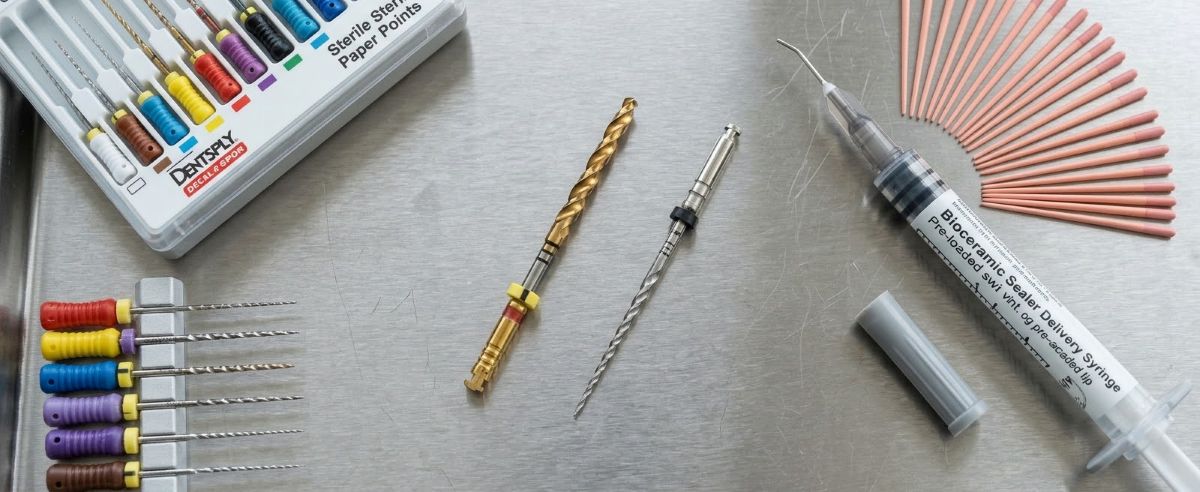
Not all endodontic products perform the same under load, and the difference rarely shows up on the invoice. It shows up months later as a separated file, a leaking sealer, or a retreatment that wasn't supposed to happen. This guide breaks down what actually makes endodontic products high-quality, where purchase price can mislead buyers, and how to evaluate files, sealers, and obturation materials before they're on your tray. For the fundamentals of stocking a complete operatory, see the endodontic supplies and instruments guide.
1. Defining Quality, Efficiency, and True Value in Endodontics
Why Purchase Price Doesn't Equal Total Cost in Endodontics
A file that costs a dollar less per unit isn't a savings if it separates on the third use. Instrument separation, extended chair time due to unpredictable cutting behavior, retreatment risk from incomplete canal shaping, and patient dissatisfaction that follows a failed root canal all cost far more than the difference in unit price. True cost has to include what happens after the invoice is paid, not just what's printed on it.
Balancing High Quality with Real-World Operatory Affordability
Quality and affordability aren't opposites in endodontics; they're just poorly matched by traditional distribution. Direct-to-clinician sourcing models let manufacturers maintain high manufacturing standards without adding multiple layers of middleman markup, which is part of why the price gap between a premium and a budget file has narrowed over the past decade. The same logic applies downstream: choosing durable dental endodontic supplies now often costs less over the full course of treatment, including whatever post-and-core system follows, than many practices assume in advance. Practices weighing that same durable-materials logic on the restorative side can see it applied directly in the dental pins and posts guide.
Product Efficiency as a Primary Driver of Practice Savings
Efficiency is where quality actually pays for itself. A smooth-cutting rotary file that shapes a canal in fewer passes, or a sealer that flows consistently without voids, shortens chair time on every single case, not just the difficult ones. Compare the two variables side by side:
-
Lower purchase price: smaller upfront cost, but higher risk of instrument separation, more chair time spent troubleshooting inconsistent cutting or flow, and a higher chance of retreatment.
-
Procedural efficiency: slightly higher unit cost, offset by fewer passes per canal, more predictable working time, and fewer callbacks for post-operative complications.
Multiplied across a full patient schedule, the efficiency side of that comparison adds up faster than most fee schedules account for.
The Role of Material Innovation in Modern Endodontics
Two material advances have done more to raise the floor on endodontic products than anything else in the past fifteen years: heat-treated NiTi metallurgy, which changed how rotary files handle curved canals, and premixed, ready-to-use bioceramics, which removed a major source of mixing-related inconsistency from sealers and repair materials. Both innovations also appear in intracanal medicaments, where premixed calcium hydroxide and bioceramic formulations have replaced older powder-liquid systems. Browsing a current collection of medicaments makes the shift toward premixed, shelf-stable formats obvious at a glance.
2. Technical Evaluation of Core Endodontic Instruments & Materials
Once the value case is clear, the next step is to understand what separates genuinely high-quality endodontic products from those that just look similar on a shelf.

What Separates Premium Rotary Files from Budget Options
Heat treatment is the single biggest differentiator between premium and budget rotary files. Gold and blue wire NiTi files undergo thermal processing that fundamentally changes the alloy's molecular behavior compared to conventional, untreated NiTi:
-
Flexibility: heat-treated files navigate curved canals with less resistance and less risk of canal transportation.
-
Cyclic fatigue resistance: the treated alloy withstands significantly more cycles before fatigue failure.
-
Torsional stress capacity: treated files tolerate more twisting force before permanent deformation or fracture, which matters most in tight or calcified canals.
Untreated files can still perform adequately in straight, wide canals, but the margin for clinician error narrows considerably in anything more anatomically demanding.
Evaluating Bioceramic Sealers and Root Repair Materials

These endodontic products should be evaluated against four criteria, not brand reputation alone:
-
Biocompatibility: minimal cytotoxicity and a favorable tissue response if the material contacts periapical tissue.
-
Dimensional stability: minimal shrinkage or expansion during setting, which directly affects long-term seal integrity.
-
ydroxyapatite formation: the material's ability to form hydroxyapatite at the dentin interface, a marker of genuine bioactivity rather than just biocompatibility.
-
Radiopacity: sufficient contrast on radiographs to confirm complete fill without guesswork.
A full collection of sealers, cements, and syringe tips makes it easier to compare these specs side by side instead of relying on a single manufacturer's data sheet.
Assessing Gutta-Percha Points, Paper Points, and Obturation Systems
Dimensional accuracy is the most overlooked spec in obturation materials. Points that are laser-inspected for consistent taper and tip size fit the prepared canal predictably, whereas points with wider manufacturing tolerances create small voids or resistance that a clinician must compensate for chairside. Stiffness matters too: a paper point that buckles on the way to working length forces a shorter dry time, which risks moisture at the sealer interface. Sourcing a full range of gutta-percha and paper points from a single, quality-controlled line reduces size-to-size variability that arises when points are mixed across brands.
Irrigation Supplies and Delivery Systems: Why Precision Details Matter
Irrigation quality comes down to details that are easy to overlook on a spec sheet: side-vented safety needles that reduce apical extrusion risk, activation devices that reach working length consistently, and chemical purity and shelf stability in the sodium hypochlorite and EDTA solutions themselves. None of this works without proper field isolation, which is covered in more depth in the dental rubber dam guide.
Choosing the Right Endodontic Instruments for Clinical Predictability
Predictability comes down to tactile feedback and the preservation of canal anatomy more than any single spec. Instruments that transmit accurate resistance back to the clinician's hand, rather than masking it, make it possible to sense a ledge, a curve, or a calcification before it becomes a procedural complication. That feedback loop is worth weighing as heavily as any published cyclic fatigue number.
3. Procurement Strategy, Quality Red Flags, and Supplier Selection
Even well-chosen endodontic products can underperform if sourcing safeguards aren't in place.
Common Quality Control Issues to Watch For When Sourcing
A quick visual and functional audit catches most sourcing problems before they reach a patient:
-
Sizing variations: files or points that measure outside stated ISO tolerances batch to batch.
-
File unwinding or visible burrs: signs of inconsistent heat treatment or poor quality control in manufacturing.
-
Poor radiopacity: sealers or points that are difficult to distinguish from surrounding tissue on radiographs.
-
Inconsistent setting times: cements or sealers that set faster or slower than the data sheet states, batch to batch.
How to Evaluate and Compare Endodontic Product Lines
Side-by-side trials beat data sheets for a final purchasing decision. Test file flexibility by hand-flexing a sample against a known reference file, check tip accuracy with a go/no-go gauge or under magnification, and evaluate sealer flowability by timing how long it takes a fixed volume to spread across a glass slab. Running the same trial across two or three product lines at once makes differences obvious that a spec comparison alone won't show.
Building a Cost-Conscious Endodontic Supply Strategy
A cost-conscious inventory model doesn't mean buying the cheapest option in every category; it means matching product tier to procedure complexity. Standard cases often run on a mid-tier file and sealer with no measurable difference in outcome, whereas complex anatomy, retreatment cases, and higher-risk canals justify the premium tier. Browsing a full endodontic products collection side by side makes that tiering decision easier than guessing from memory.
The Value of Specialty Focus, Broad Inventory, and Personalized Support
A distributor that specializes in endodontics, rather than treating it as one category among dozens, tends to offer lot-tracked inventory, more consistent stock on less common sizes, and direct technical support when a product doesn't behave as expected. That specialty focus, paired with a genuinely broad endodontic accessories inventory, means fewer substitutions mid-procedure and fewer surprises at reorder time.
4. Frequently Asked Questions
How do high-quality endodontic materials directly reduce root canal failure rates?
-
High-quality bioceramic sealers reduce the risk of failure by preventing microleakage and fluid percolation along the canal walls, which are among the most common pathways for bacterial re-entry after treatment. High-precision files reduce failure risk in the opposite direction by ensuring complete canal shaping, preventing uninstrumented anatomical pockets where bacteria can persist. Together, both factors close off the two main routes to post-treatment reinfection.
What are the most common signs that a root canal treatment has failed due to material breakdown?
The most common signs are periapical radiolucency visible on a follow-up radiograph, persistent post-operative pain or swelling beyond the expected healing window, and sinus tract formation near the treated tooth. Gutta-percha shrinkage or void formation within the fill is a frequent underlying cause, since it creates space for bacteria to re-establish before any of these symptoms become apparent.
What role do premium files play when treating teeth with high failure rates, like maxillary molars?
Complex root anatomy, including severe canal curvature and MB2 canals common in maxillary molars, demands the cyclic fatigue resistance and flexibility that only gold or blue heat-treated NiTi files reliably provide. Standard files are more likely to separate, ledge, or transport the canal in this anatomy, any of which can compromise the entire treatment outcome regardless of how well the rest of the procedure goes.
What makes heat-treated nickel-titanium (NiTi) files superior to standard rotary files?
Heat treatment alters the alloy's crystal structure, shifting it toward a martensitic phase that dramatically increases flexibility and cyclic fatigue resistance compared to traditional austenitic NiTi. The trade-off is reduced shape memory, meaning the file doesn't spring back to its original form as forcefully as an untreated file, which is actually an advantage in a curved canal, since it reduces the stress the file transmits back into the canal wall.
Why is dimensional accuracy critical when selecting gutta-percha and paper points?
Dimensional accuracy determines whether the master point fits predictably to the apical constriction, rather than requiring chairside adjustment. Strict ISO tip sizing and taper consistency maintain hydraulic pressure during obturation, which helps the material fill lateral canals and irregularities without overextending the sealer or gutta-percha into the periapical tissue.
Where can dental practices reliably source high-quality endodontic products?
Practices that want to reliably order endodontic supplies for dentists should source directly from specialized endodontic manufacturers or authorized distributors, rather than general marketplaces with unclear supply chains. Look for lot-tracked inventory, ISO-certified manufacturing controls, and a dedicated clinical support line, since all three indicate a supplier that can stand behind product consistency batch after batch.
Buy Endodontic Products Online From a Trusted Source
Consistent outcomes start with consistent materials, not a different file or sealer every time stock runs low. Alpine Dental Inc. carries high-quality endodontic materials, including files, sealers, obturation systems, and accessories, for practices across the United States and Canada, helping standardize their endodontic inventory.