
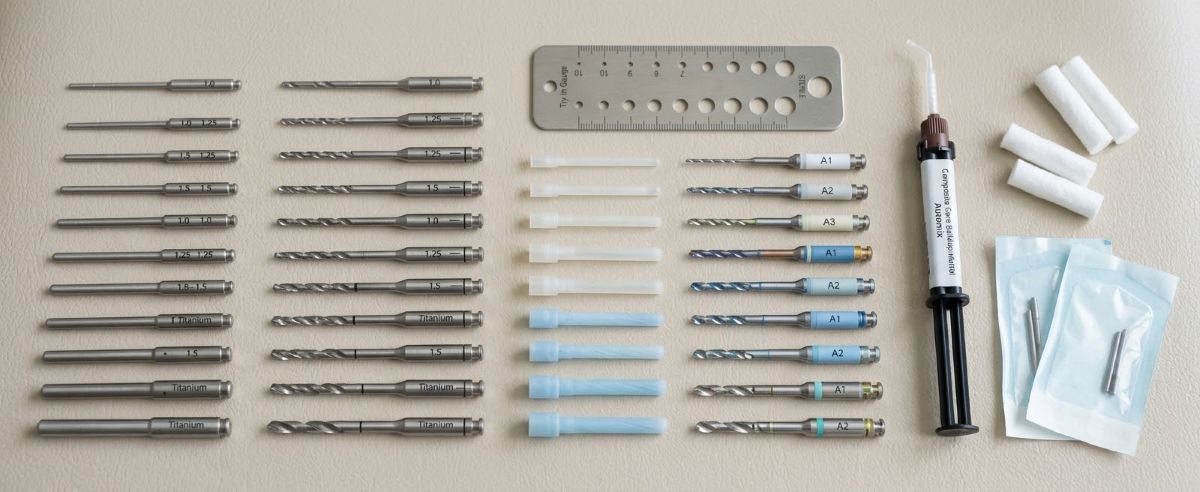
With modern adhesive bonding advancing rapidly, mechanical retention is used less often than it once was, but it hasn't disappeared. The real question for clinicians isn't whether dental pins and posts still have a place in restorative dentistry; it's knowing exactly when mechanical retention is still required and how to choose between a pin and a post without risking root fracture. This guide breaks down the fundamentals, the material and brand decisions that matter most, and what to keep stocked so the choice is never made under time pressure.
1. Fundamentals of Auxiliary Retention: Pins vs. Posts
Choosing correctly between dental pins and posts starts with understanding where each device sits anatomically and what job it's actually doing.
Anatomical Location & Purpose
A dental pin is placed directly into sound dentin of a vital or non-vital tooth to retain a core buildup material when there isn't enough remaining tooth structure for the core to hold onto by itself. A post, by contrast, is placed inside the obturated root canal space of an endodontically treated tooth, using the canal itself as the anchor point for a core. Both fall under the broader posts and pins collection, but they solve different structural problems and are never interchangeable.
Dentin Mechanics
Neither a pin nor a post strengthens the tooth. That's worth repeating, because it's the most common misconception in restorative planning: both devices exist solely to provide retentive structure for the final restoration, not to reinforce the remaining dentin. Root canal-treated teeth that fracture do so because of lost tooth structure and reduced moisture content, not because a post was or wasn't placed.
The Ferrule Effect
Long-term success depends far more on the ferrule effect than on which post system gets chosen. A minimum of 1.5 to 2.0 mm of circumferential sound dentin above the crown margin gives the final restoration a band of natural tooth structure to grip, and this single factor predicts survival better than post material, length, or brand. For a closer look at how post placement fits into a complete endodontic workflow, see the endodontic supplies and instruments guide.
Clinical Risks
Pin and post placement carry different failure modes, and the risk profile should factor directly into the decision:
-
Pin risks: dentinal crazing, micro-cracks radiating outward from the pin channel, and pulp exposure if the pin is angled incorrectly or placed too close to the pulp chamber
-
Post risks: vertical root fracture from excessive post diameter or aggressive cementation pressure, and canal perforation during post space preparation, particularly in curved or narrow roots.
2. Material Selection and Post System Clinical Decisions
Once a post is indicated, the decision shifts to material and brand. Selecting high-quality dental pins and posts starts with matching modulus of elasticity to the clinical situation, not defaulting to whatever's on the shelf.
When to Place a Post
A post is generally indicated after endodontic therapy when a tooth has lost more than 50 percent of its coronal structure, when there's no ferrule remaining to grip, or when the final restoration needs to resist multi-surface occlusal forces without a strong dentin base to anchor to. If enough coronal structure remains, a direct composite core without a post is usually the more conservative, lower-risk option.

Material Matrix: Fiber vs. Metal and Titanium Posts
-
Glass and quartz fiber posts have a modulus of elasticity close to dentin, roughly 18 to 22 GPa, so they flex and distribute stress more evenly along the root instead of concentrating it at one point. They're highly aesthetic under all-ceramic restorations and relatively easy to retrieve if retreatment becomes necessary.
-
Stainless steel and titanium posts have a much higher modulus of elasticity than dentin, which concentrates stress at the apex of the post space. This raises the risk of a vertical root fracture that, unlike a fiber post failure, is often unrecoverable.
Brand & Design Comparisons
-
ParaPost uses a passive, parallel-sided design that seats with minimal stress, making it a versatile choice for standard, relatively straight canals. Browse the full ParaPost system lineup for kits matched to canal diameter.
-
Flexi-Post uses an active, threaded, split-shank design that absorbs seating stress as it's placed, delivering high retention, though over-tightening raises the risk of dentin microfracture. The Flexi-Post and Flexi-Flange systems come with matching drills sized to each post diameter.
-
Integra uses a passive, parallel-sided design with a round Flow-Thru Head that funnels core material through the post head for complete post-and-core integration. The Integra post system is stocked in assortments covering the most common canal sizes.

Post Placement Workflow
A standard post placement follows the same general sequence regardless of brand: post space preparation to the manufacturer's specified depth, a dry try-in to confirm passive fit, silanization and bonding of the post surface, and, finally, core buildup material is placed and cured around the seated post.
3. Operatory Management, Maintenance, and Inventory
Long-Term Prognosis
Radiographic monitoring should track three things over time: microleakage at the post-core-crown interface, gradual post dislodgement, and root fracture lines that become visible only after they've propagated under repeated occlusal load. None of these show up reliably on a single check-up film, which is why a baseline radiograph taken at cementation is important for later comparison.
Essential Dental Pins and Posts Stocking Checklist
A complete operatory setup for dental pins and posts covers four categories:
-
Post Drills & Reamers: Size-matched to each post kit and color-coded to prevent using the wrong drill diameter for a given post.
-
Fiber Posts: Standard assortments across 0.5 mm, 1.0 mm, and 1.5 mm diameters cover the majority of canal sizes encountered in general practice.
-
Pins: Self-threading, color-coded friction-lock pin systems with matching pilot drills, sized to the range of dentin thickness typically available in coronal tooth structure.
-
Chemicals & Adhesives: Silane coupling agents, dual-cure resin cements, and core buildup composites, all with tracked expiration dates since bond strength degrades once these products expire.
Practices that buy dental pins and posts online from a single distributor also simplify reorder tracking across all four categories. Stocking a full collection of pins, posts, and accessories in one place means a missing drill size or an expired silane never delays a restoration that's otherwise ready to go.
4. Frequently Asked Questions (Clinical Pins & Posts)
What is the primary difference between dental pins and posts?
-
A pin is anchored directly into coronal dentin on a vital or non-vital tooth, while a post is anchored inside the root canal space of a tooth that's already been endodontically treated. Pins support a core buildup when there isn't enough natural tooth structure to hold one on its own, and posts do the same job using the emptied canal as the retention point instead of dentin alone.
How long do dental posts typically last?
-
Dental posts can last 10 to 15 years or longer, but survival depends far more on remaining ferrule, crown margin integrity, and occlusal habits than on the post itself. A well-placed fiber post in a tooth with adequate ferrule and a well-sealed crown margin will typically outlast a premium post placed in a tooth without enough remaining structure to support it.
Can dental pins be safely removed if a restoration fails?
Removing a dental pin is difficult and carries real risk, since it often causes further dentin loss or a fracture during removal. Ultrasonic instrumentation is the standard approach when removal is unavoidable, but in most failed-restoration cases, replacing the pin-retained core with a bonded composite core is the preferred, lower-risk path forward.
Do dentists still use posts in modern adhesive dentistry?
Yes, but far less frequently than a generation ago. High-bond-strength adhesives and fiber post systems have largely replaced cast metal posts and have driven down overall post placement rates, since many teeth that once required a post can now be restored with a direct composite core alone.
Can tooth pins be used on any tooth type or anatomical location?
No, pins require adequate dentin bulk and specific anatomy to be placed safely. They must avoid pulp chambers, furcations, and external root surfaces, which makes them contraindicated in thin anterior teeth and in posterior teeth near a furcation where dentin thickness can't reliably support a pin channel.
Shop Dental Pins & Posts Supplies From a Trusted Source
Predictable results with dental pins and posts start with having the right system on hand before the post space is even prepped. Alpine Dental Inc. carries the ParaPost, Flexi-Post, and Integra systems, along with a full range of pins and accessories for practices across the United States and Canada, helping standardize their restorative inventory