
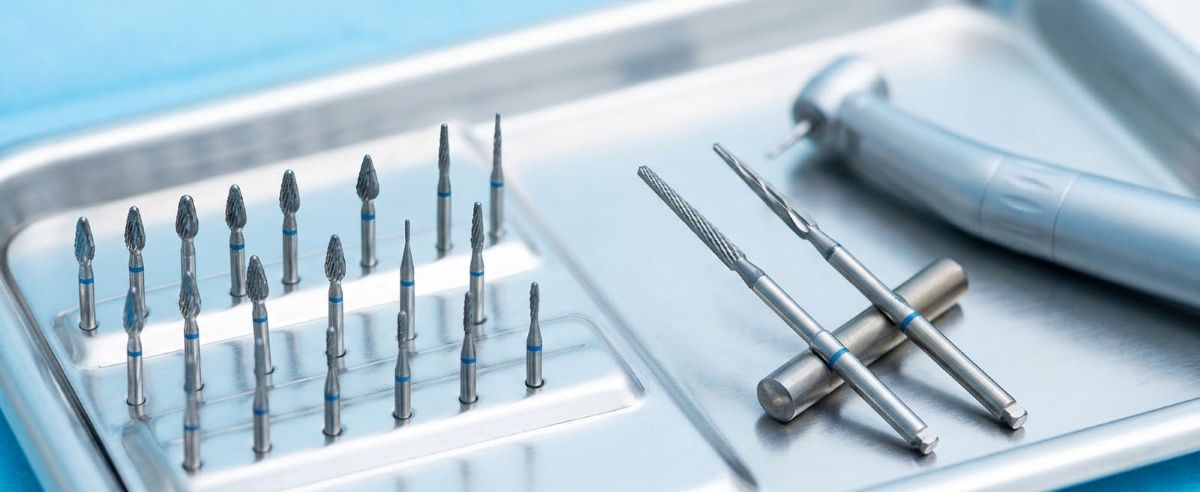
Selecting the correct dental bur directly dictates clinical efficiency, handpiece longevity, and patient outcomes. Whether performing conservative operative preparations or complex impacted tooth extractions, understanding rotary instrument engineering (from blade geometry to ISO classifications) is essential for modern dental practice.
Balancing Operative Precision and Surgical Power
Rotary instruments generally function through two distinct cutting mechanisms: shearing action and abrasive grinding action.
Shearing Blade Action (Carbide Burs): Tungsten carbide shearing blade instruments utilize precision-milled flutes with negative rake angles to slice through dental substrate. This mechanism minimizes micro-fractures in dentin and enamel while generating less frictional heat when combined with water spray.
Abrasive Grinding Action (Diamond Burs): Diamond burs rely on electroplated diamond grit to grind down structure, making them effective for enamel reduction but generating greater surface roughness and thermal friction.
Clinical Trade-offs: Operative vs. Surgical Rotary Tools
The choice between operative and surgical instruments depends on the balance of tactile response and structural clearance needed for the procedure.
|
Feature / Goal |
Operative Work |
Surgical Work |
|
Primary Requirement |
Tactile sensitivity & minimal pulp heat |
Rapid debris clearance & high torque resistance |
|
Bur Characteristics |
Shorter head lengths & standard FG shanks |
Extended shanks (FGXL/HP) & wide flute spacing |
|
Cutting Goal |
Smooth, defined margins without micro-cracking |
Clog-resistant sectioning of bone & tooth structure |
Understanding ISO Classifications & Engineering
To standardize global manufacturing, the International Organization for Standardization developed the ISO 6360 standard, which assigns a unique 15-digit code to every dental bur.
Example Code: 500 314 237 000 080
│ │ │ │ └── Head Diameter (0.80 mm)
│ │ │ └────── Flute / Grit Design
│ │ └────────── Head Shape (Pear)
│ └────────────── Shank Type (FG Standard)
└────────────────── Material (Tungsten Carbide)
Decoding the 15-Digit ISO Standard (ISO 6360)
-
Material Type (Digits 1–3): Defines the working head composition (e.g., 500 = Tungsten Carbide, 806 = Electroplated Diamond).
-
Shank Type & Length (Digits 4–6): Identifies handpiece compatibility and overall length (e.g., 314 = Friction Grip Standard / 19 mm, 316 = Friction Grip Surgical / 25 mm, 104 = Handpiece Straight / 44.5 mm, 204 = Right Angle Latch / 22 mm).
-
Head Shape & Geometry (Digits 7–9): Specifies the profile (e.g., 237 = Pear profile, 137 = Tapered Fissure, 001 = Round).
-
Grit / Flute Design (Digits 10–12): Indicates blade configuration (e.g., plain cut vs. cross-cut, or 6-flute operative vs. 12/30-flute finishing).
-
Head Diameter (Digits 13–15): Measures maximum working head diameter in 1/100th of a millimeter (e.g., 080 = 0.80 mm diameter).
Monoblock Construction vs. Joint-Welded Shanks
Burs are manufactured as either monoblock (solid single-piece tungsten carbide) or joint-welded (carbide head brazed to a stainless steel shank). Monoblock construction offers high concentricity, virtually eliminating runout (wobble). Lower runout minimizes handpiece turbine wear, prevents head detachment under lateral loads, and provides cleaner margins during operative prep.

The Workhorse Operative Bur: The 330 Pear-Shaped Carbide
The 330 carbide bur (FG, 10‑pack) serves as a primary rotary instrument for conservative restorative dentistry.
┌─ 0.8mm ─┐
┌───────────┐ ──┐
│ ( ) │ │ 1.9mm Head Length
│ \ / │ │
└───┴─┴─────┘ ──┘
Slightly Inverted
Pear Profile
Geometry Specifications
-
Profile: Pear-shaped with a rounded, slightly tapered design.
-
Head Diameter: ~0.8 mm at its widest dimension.
-
Head Length: ~1.6–2.0 mm (varies slightly by manufacturer).
-
Edge Geometry: Rounded transitions at internal blade intersections.
Clinical Advantages
-
Controlled Cavity Form: The pear profile allows smooth internal line angles and controlled axial wall extension, supporting retention form when combined with proper cavity design.
-
Stress Reduction: Rounded internal corners eliminate sharp line angles. This stress distribution helps prevent micro-cracking in enamel and dentin, improving long-term restoration outcomes for composite and amalgam fillings.
-
Clinical Applications: Class I, II, and III cavity preps, pediatric restorative procedures, and conservative occlusal access.
Pro-Tip: Operating Parameters
-
RPM Range: Run the 330 bur in high-speed handpieces at approximately 150,000 to 250,000 RPM under continuous water coolant.
-
Technique: Apply light brushing pressure (< 2 oz / ~50 g). Let the shearing action of the blades do the work: excessive pressure generates friction and causes premature blade dulling.
Specialty Burs for Bone Surgery & Oral Surgery
Transitioning into oral and maxillofacial procedures requires moving from standard operative instruments to specialty burs for bone surgery.
Shank Length Comparison:
Standard FG (19mm) [====||========]
Surgical FGXL (25mm) [====||──────────────]
Surgical HP (44.5mm) [====||───────────────────────────────]
Standard operative shanks (FG 19mm) lack the length necessary for deep surgical sites. Surgical shanks (FGXL 25mm or HP 44.5mm) provide the clearance needed to maintain line of sight and maneuver around adjacent teeth or soft tissue flaps.
H3: Essential Surgical Rotary Instruments
Lindemann Burs: Feature cross-cut helical blades engineered to clear bone chips and tooth structure rapidly without clogging during osteotomy and bone contouring procedures.
Round Surgical Burs (#4, #6, #8 HP): Used for troughing around roots, apical resections, and creating initial cortical bone entry points.
Preventing Thermal Osteonecrosis
Cutting bone generates friction. Bone tissue subjected to temperatures exceeding 47°C (116.6°F) for longer than one minute undergoes irreversible cellular death (thermal osteonecrosis). Copious, targeted irrigation with sterile chilled saline is essential to maintain tissue viability and support post-operative healing.

Spotlight on Zekrya Surgical Burs: Precision Tooth Sectioning
For surgical extractions and tooth sectioning, Zekrya surgical tungsten carbide burs (10‑pack) provide high lateral cutting performance.
Hemispherical Non-Cutting Tip
┌───┐
( ) <-- Soft Tissue Protection
│/ /│
│ / /│ <-- 6 Helical Cutting Flutes
│/ /│
┌─┴───┴─┐
Engineering and Design Features
-
Cutting Head: Extended, tapered profile integrated with 6 helical cutting flutes that lift debris out of the surgical site.
-
Tip Design: Zekrya burs feature a hemispherical tip that may be cutting or modified depending on the model; the 6 helical lateral flutes provide the primary sectioning action.
-
Lateral Shear Capabilities: Designed to cut efficiently along its lateral surfaces, slicing through enamel, dentin, and existing dental metals with low handpiece chatter.
Primary Applications
-
Sectioning multi-rooted mandibular and maxillary molars.
-
Surgical crown splitting and root separation in impacted third molar cases.
Sectioning Technique Note:
Always cut approximately 2/3 to 3/4 of the way through the tooth structure toward the lingual or palatal aspect. Stop short of full depth to protect the lingual nerve and cortex, then insert a straight elevator into the channel and rotate to complete the split cleanly.
Operative Quality Standards & Manufacturing Excellence
High-volume dental practices require durable, precise instruments. Selecting quality carbide and diamond burs ensures predictable clinical performance.
Manufacturing Benchmarks: Premium burs rely on micro-grain tungsten carbide formulations ground using multi-axis CNC technology. This process maintains flute sharpness over multiple uses and ensures high concentricity.
Clinical and Financial Benefits:
Zero-runout manufacturing protects handpiece air turbines and bearings from uneven centrifugal loads.
Corrosion-resistant shank alloys withstand repeated sterilization cycles without rusting.
Cost-Per-Procedure Value: While low-cost generic burs may reduce initial spend, they often chatter in the handpiece, dull quickly, and risk head detachment at the neck joint, costing more in lost chair time and replacement parts.
To evaluate dental equipment and supplies for your practice, consult this comprehensive guide on buying dental supplies.
Maintenance, Sterilization & Instrument Safety
Proper handling extends tool life, prevents cross-contamination, and keeps rotary tools working efficiently.
Cleaning Step: Enzymatic Bath / Automated Washer
│
▼
Rinsing/Drying: Thorough Drying (Prevents Joint Corrosion)
│
▼
Steam Autoclave: 121°C (250°F) or 134°C (273°F) Cycle
Cleaning & Sterilization Protocols
-
Ultrasonic Pre-Cleaning: Submerge burs in an enzymatic cleaning solution to remove organic debris. Avoid harsh, non-buffered phenols or bleach, which corrode carbide matrix material.
-
Drying Cycle: Ensure burs are completely dry before pouching and autoclaving. Residual moisture trapped in sterilization pouches causes corrosion at head-to-shank welds.
-
Autoclave Settings: Process using standard steam autoclave cycles at 121°C (250°F) for 30 minutes or 134°C (273°F) for 4–5 minutes.
Pre-Procedure Safety Check
Inspect blades under magnification for chipped, cracked, or dull flutes.
Discard bent shanks immediately; running a bent bur at high speed causes severe vibration, destroys handpiece turbines, and poses a fracture risk.
Frequently Asked Questions
Are carbide dental burs single-use or reusable?
-
Most high-precision operative carbide burs are cleared for multi-use through proper cleaning and autoclaving. For surgical burs (including Zekrya and Lindemann types used in bone cutting), practices vary: some prefer single-patient use to ensure peak sharpness and simplify infection control, while others successfully reuse surgical carbide burs when they follow strict sterilization protocols.
What factors influence the cost of operative vs. surgical carbide burs?
-
The cost is primarily determined by raw material quality (fine-grain tungsten carbide), manufacturing technique (single-piece solid carbide vs. welded two-piece construction), shank length (standard FG vs. extended HP/surgical shanks), and precision quality testing (concentricity and balance testing).
How do you read ISO numbers and color bands on dental burs?
-
Every dental bur carries a 15-digit ISO classification number that specifies the material composition, shank diameter/length, head geometry, and tip diameter. Color bands on diamond burs indicate grit size (coarse, medium, fine), whereas carbide burs are identified by bur number and flute configuration (e.g., 6-flute for operative cutting vs. 12–30-flute for trimming and finishing).
What is the difference between operative and surgical carbide burs?
-
Operative burs (like the 330 carbide bur) feature shorter head lengths and standard 19mm FG shanks designed for conservative cavity preparations, caries removal, and margin creation. Surgical burs feature extended shanks (25mm FGXL or 44.5mm HP), specialized blade geometry (such as Zekrya or Lindemann flutes), and are engineered for high-torque bone removal, tooth sectioning, and deep surgical access.
When should a dental bur be replaced or discarded?
-
Discard a bur immediately if you notice reduced cutting speed, increased handpiece vibration/chatter, visible flute wear or chipping, corrosion after autoclaving, or any bend in the shank. Using a worn bur increases heat generation, pulp trauma, and treatment time while damaging handpiece bearings.
Upgrade Your Operative & Surgical Workflow
Precision cutting instruments save chair time, protect equipment, and improve patient outcomes.
Equip your practice with high-concentricity 330 carbide burs, Zekrya surgical burs, and premium diamond rotary tools engineered for exceptional performance by Alpine Dental Inc. Explore the Complete Alpine Burs Collection Today to upgrade your clinical setup.