
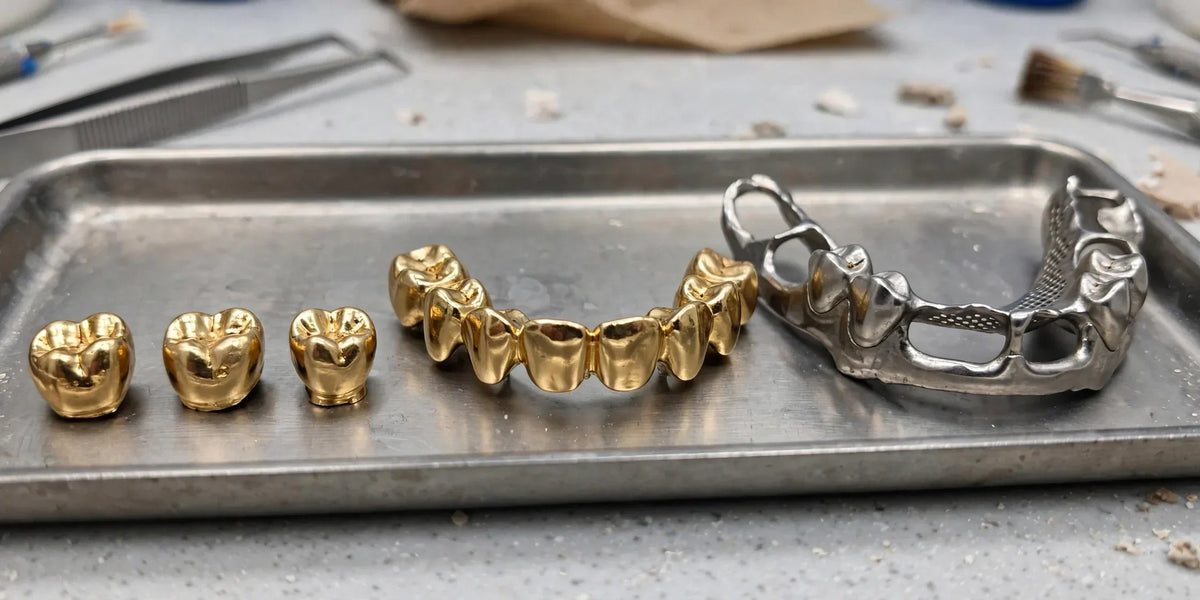
Choosing the right dental alloy comes down to balancing four variables at once: mechanical strength, biocompatibility, esthetic demand, and lab cost. Get the balance wrong, and you end up with porcelain fracture, patient sensitivity, or a lab bill that eats your case margin. This guide breaks down the major alloy categories, the physical properties that actually matter chairside and in the lab, and how to match alloy selection to the restoration you’re placing.
What Are Dental Alloys?
A dental alloy is a metal or metal-blend substrate used to fabricate indirect restorations: crowns, bridges, removable partial denture (RPD) frameworks, and implant superstructures. Alloys are also used directly, most notably in dental amalgam for posterior restorations. Selection depends on where the metal sits in the mouth, whether it will be layered with porcelain, and how much load it needs to bear over the life of the restoration.
The American Dental Association (ADA) classifies alloys by noble metal content rather than by trade name, which is the framework labs and practices should use when comparing options rather than relying on manufacturer marketing terms alone.

Understanding the 4 Major Dental Alloy Categories
High-Noble & Noble Alloys
High-noble alloys contain at least 60% noble metal by weight, with a minimum 40% gold content. Noble alloys require at least 25% noble metal content (gold and platinum-group metals such as palladium and platinum); silver, if present, doesn’t count toward the noble metal percentage. Both categories offer excellent corrosion resistance and tissue tolerance, making them a dependable choice where biocompatibility is the priority and case budget allows.
Base Metal Alloys
Base metal alloys, primarily nickel-chromium (Ni-Cr) and cobalt-chromium (Co-Cr), contain no noble metal content. They offer higher yield strength and stiffness than noble alloys at a lower material cost, which is why they dominate RPD frameworks and long-span bridge substructures. The tradeoff is a higher allergenic potential, particularly with nickel-containing formulations.
Porcelain-Fused-to-Metal (PFM) Alloys
PFM alloys aren’t a separate metal category so much as a functional requirement: the alloy’s coefficient of thermal expansion (CTE) must closely match the porcelain layered over it. A mismatch here is one of the leading causes of porcelain fracture and marginal chipping. Noble, high-noble, and select base metal alloys are all manufactured in PFM-compatible formulations, so CTE compatibility needs to be confirmed against the specific porcelain system your lab uses, not assumed by alloy category alone.
Dental Amalgam Alloys
Dental amalgam is a direct-fill alloy, typically a mixture of silver, tin, copper, and mercury, triturated chairside and condensed directly into the prepared tooth. It remains distinct from the indirect alloys above because it sets in place rather than being cast and cemented. The Minamata Convention calls for a global phase-down of dental amalgam by 2034, but current ADA guidance still supports its use where clinically appropriate.
Key Factors to Evaluate Before Selecting an Alloy
Biocompatibility & Corrosion Resistance
Noble and high-noble alloys resist oral fluid corrosion better than most base metal formulations, which matters most for patients with a documented metal sensitivity or a history of galvanic irritation. Nickel sensitivity is the most commonly flagged allergy risk with base metal alloys, and it’s worth screening for before specifying a Ni-Cr framework.
Mechanical Strength & Wear Characteristics
Yield strength determines how much a framework or crown margin can flex before it deforms permanently. Base metal alloys generally outperform noble alloys here, which is why long-span bridges and RPD frameworks lean base metal even when cost isn’t the deciding factor. Wear rate against the opposing dentition also varies by alloy hardness and matters more for full-arch implant cases than for a single posterior crown.
Material & Lab Cost Considerations
Noble metal pricing tracks commodity gold and palladium markets, so alloy cost per unit can shift month to month independent of your lab’s fees. Base metal alloys offer more predictable, stable pricing, which is a real consideration for practices running high case volume or standardizing lab protocols across multiple providers.
Matching the Alloy to the Restoration Type
Single-Unit Crowns
Full-cast noble or high-noble crowns remain a reliable choice where esthetics are less critical than long-term marginal fit, particularly on second molars. For PFM single crowns, alloy selection should follow the porcelain manufacturer’s CTE compatibility chart.
Fixed Partial Dentures (Bridges)
Longer spans need higher yield strength to resist flexure under occlusal load, favoring base metal or high-noble alloys over standard noble formulations. This is also where CTE matching becomes more critical, since a longer porcelain run has more surface area at risk of fracture.
Removable Partial Denture (RPD) Frameworks
Co-Cr is the standard for RPD frameworks because of its rigidity-to-weight ratio and resistance to permanent deformation under repeated insertion and removal. Ni-Cr is a lower-cost alternative but carries a higher allergy flag rate.
Implant-Supported Prosthetics
Implant superstructures see cyclic loading over years of function, which makes fatigue resistance a bigger factor than in a single crown. Titanium and high-noble alloys are both common choices here, with selection often driven by the specific implant system’s abutment interface rather than alloy category alone.

Amalgam vs. Modern Composite & Cements: When Is Amalgam Still Used?
Amalgam use has declined as composite resin and modern restorative cements have improved in wear resistance and esthetics, but it still has practical clinical uses. Current ADA guidance recognizes amalgam as a safe and effective restorative material, and it still holds advantages in high-moisture posterior preparations and cases where isolation for a composite bond is genuinely difficult to achieve. Practices stocking both direct-fill options can review Alpine’s amalgam collection alongside a compatible amalgamator for consistent trituration timing, and matrix retainer systems for proper interproximal contact on posterior amalgam or composite restorations.
Buyer’s Checklist: Ordering Dental Alloys Online
Before placing an order for dental alloy products, confirm the following:
-
Purity certification: Request a certificate of analysis confirming noble metal content matches the labeled classification.
-
ADA acceptance or regulatory clearance: Verify the alloy meets applicable regulatory standards for your region before it goes into a patient’s mouth.
-
Current noble metal market rate: Since gold and palladium pricing fluctuates, confirm your quoted price reflects current market rates rather than a stale catalog listing.
-
Authorized distributor sourcing: Buying high-quality dental alloy from an authorized distributor protects you from counterfeit or relabeled stock, which is a real risk in the noble metal supply chain.
-
CTE documentation for PFM cases: Confirm thermal expansion data is available if the alloy will be layered with porcelain.
Practices building out a full restorative order can browse Alpine’s dental alloy collection for the best dental alloys across noble, high-noble, and base metal categories, and cross-reference material selection against the broader restorative dental supplies guide for related cements, liners, and finishing materials.
Frequently Asked Questions
What percentage of noble metal does the ADA require for an alloy to be classified as noble?
-
The ADA requires at least 25% noble metal content (gold and platinum-group metals such as palladium and platinum) for an alloy to be classified as noble, and at least 60% (with a 40% minimum gold content) for high-noble classification. Alloys below 25% noble metal fall into the base metal category regardless of trade name.
Is nickel allergy a real concern with base metal alloys?
-
Yes. Nickel sensitivity is one of the more common metal allergies in the general population, and Ni-Cr alloys carry the highest allergy flag rate among common dental alloys. Patients with a known nickel sensitivity or a history of contact dermatitis from jewelry should be screened before specifying a nickel-containing framework, with Co-Cr or a noble alternative considered instead.
What typically causes PFM bonding or porcelain fracture failures?
-
The leading cause is a coefficient of thermal expansion mismatch between the alloy substrate and the porcelain layered over it. Surface contamination during the lab’s oxidation or degassing steps and insufficient metal framework thickness at the porcelain margin are the next most common contributors.
Can I mix alloy types across a single bridge or partial denture framework?
-
Generally no. Mixing dissimilar alloys in a single casting increases the risk of galvanic corrosion and unpredictable mechanical behavior at the junction point. Framework fabrication should use a single, consistent alloy specification from start to finish.
Does a higher gold content always mean a stronger alloy?
-
No. Gold content relates to noble classification and corrosion resistance, not mechanical strength. In fact, many base metal alloys with no gold content outperform high-noble alloys on yield strength and rigidity, which is why they’re preferred for long-span bridges and RPD frameworks despite containing no precious metal.
Where to Source Your Dental Alloys
-
Selecting the right alloy is a material science decision as much as a budget one, and getting it wrong shows up later as remakes, sensitivity callbacks, or porcelain failures that cost more than the alloy ever saved. For practices and labs ready to standardize their restorative material sourcing, Alpine Dental Inc carries a full range of alloys, amalgam, and related restorative supplies backed by responsive support for procurement questions.